
Texas City Address History Sources
One address can leave several trails, each covering a different era. Start with the current parcel record because it provides the identifiers that connect the street address to a legal description. Then choose the next source by date. A deed establishes a recorded transfer. A directory or telephone book can place a person at an address in a particular year. A census provides a dated household snapshot. A permit, newspaper item, or probate file may explain a change without proving title.
| Source | Years it covers | Where held | What it shows |
|---|---|---|---|
| GCAD appraisal and GIS | GIS mapping complete since 1997; current layers dated April 14, 2026; historical display cutoff not stated | GCAD eSearch and map | Current owner, legal and location clues; not every occupant |
| County Clerk AVA deed index | Earliest online year not stated; older books and counter remain a fallback | AVA and County Clerk offices | Recorded transfers and legal descriptions |
| Texas City directories | 1938; 1941-42; 1944; 1947; 1949; 1951-52; 1957-58 | Moore Memorial archive | Dated address, telephone, and household clues; donation gaps |
| Texas City and La Marque telephone books | 1963-1993, not inclusive | Galveston & Texas History Center reading room | Address and telephone continuity clues |
| Texas City Sun microfilm | 1934-2004 | Moore Memorial Local History | Obituaries, notices, and local-event references; no complete index |
| Federal census | Public schedules follow the 72-year release rule | NARA-authorized resources and libraries | Household snapshot at the census date |
| MGO permits and inspections | New city processing from June 4, 2025; earlier online cutoff not stated | MGO and Building Inspections | Alteration, inspection, and applicant clues |
Texas City previous residents research needs the access fallback as much as the web link. Moore originals require an appointment and staff-supervised use, and the County Clerk can answer questions about deed books, certified copies, and a public terminal when AVA does not reach far enough back.
Freeze Texas City Parcel Facts
Use GCAD eSearch to record the current situs address, owner name, mailing address, property ID, geographic ID, subdivision or abstract, lot and block, and legal description. Keep the situs and mailing fields separate. A situs address is the physical parcel location. A mailing address is the destination for tax correspondence and can be outside Texas City. The appraisal card is a current clue, not a complete account of who lived there before.
The legal description is the durable bridge. Street names, unit forms, and city limits can complicate an old-address search, while a subdivision, lot, block, abstract, or survey description can remain usable in the recorded documents. Compare the parcel on the GCAD map before assuming that an adjacent lot or similarly named street is the same property.
Trace Texas City Deed Chains
Recorded deeds are the title trail for Texas City previous residents who also owned the property. The County Clerk identifies AVA as its real-property search route. Search the current owner as grantee to locate the acquisition deed, then read the prior grantor and legal description. Search that prior owner as grantee in an earlier range. A replat, estate conveyance, corporate name, release, foreclosure, or changed legal description can explain an apparent break in the sequence.
- Copy the current GCAD property and geographic IDs, situs, owner, and legal description exactly.
- Open the Galveston County AVA real-property index and find the current owner as grantee, using the legal description when an address route is unavailable.
- Save the instrument or document number, recording date, volume or book-page, grantor, grantee, and any available image information from the acquisition deed.
- Search the prior grantor as a grantee in an earlier date range. Compare the legal description before accepting a name match.
- Repeat until the online index ends, then ask the County Clerk for earlier deed books, indexes, terminal access, or certified-copy procedures.
- Grantor
- The person or entity transferring an interest in the recorded instrument.
- Grantee
- The person or entity receiving that interest in the recorded instrument.
- Chain of title
- The sequence of recorded transfers used to trace ownership backward through time.
- Legal description
- The lot, block, subdivision, abstract, survey, or metes-and-bounds wording that identifies land beyond a street address.
Record flow: current GCAD parcel → current grantee deed → prior grantor → earlier grantee deed → clerk counter when the online trail ends.
Texas City AVA Counter Fallback
Do not assign AVA an earliest online year. Galveston County's accessible official pages do not state one. When a prior owner disappears from the online results, use the County Clerk records-search hub and ask the custodian about older books, indexes, copies, or a public terminal. The County Clerk maintains a Records & Elections Center in Texas City and its main Justice Center counter in Galveston. The published general office hours are Monday through Friday, 8 a.m. to 5 p.m.
Library microfilm and FamilySearch can be useful historical leads, but the County Clerk's instrument remains the authoritative deed source. A recorded document's grantor, grantee, date, instrument number, and legal description should be preserved before moving to the next record.
Note: An online gap is a records-access question, not proof that a transfer or an earlier owner never existed.
Texas City Previous Residents in Print
Directories and telephone books add the household layer to the deed trail. Moore Memorial's local Texas City directory runs are discontinuous, so a missing year may reflect a donation gap rather than an absence of publication. The local archive also offers Texas City Sun microfilm, census microfilm, yearbooks, and reference help. For later decades, Rosenberg's Galveston & Texas History Center lists Texas City and La Marque telephone directories for 1963-1993, with its not-inclusive warning.
The Texas State Library and Archives city-directory guidance is the source shown in this Texas City previous residents image.

An entry can include a name, address, telephone, spouse or relationship notation, occupation or business details, and sometimes a publisher's ownership-status mark. Those fields vary by volume. Search surname forms, initials, and alternate spellings, then compare the exact street and an adjacent year.
Household flow: directory year and street form → nearest public census schedule → later telephone book or newspaper → deed and probate evidence. The historical volumes themselves are described in the Texas City city directory collections.
Texas City Address Continuity Clues
Street continuity deserves caution. The accessible official material does not identify a definitive Texas City street-renumbering year, citywide renamed-street list, or annexation crosswalk. Do not invent one. Instead, compare a historical map, the recorded plat, the GCAD legal description, and planning or engineering records when a street name or number seems to change. A postal city, city boundary, and parcel description can each use a different geographic convention.
Texas City's incorporation and early-development history is the source for this previous-residents image.
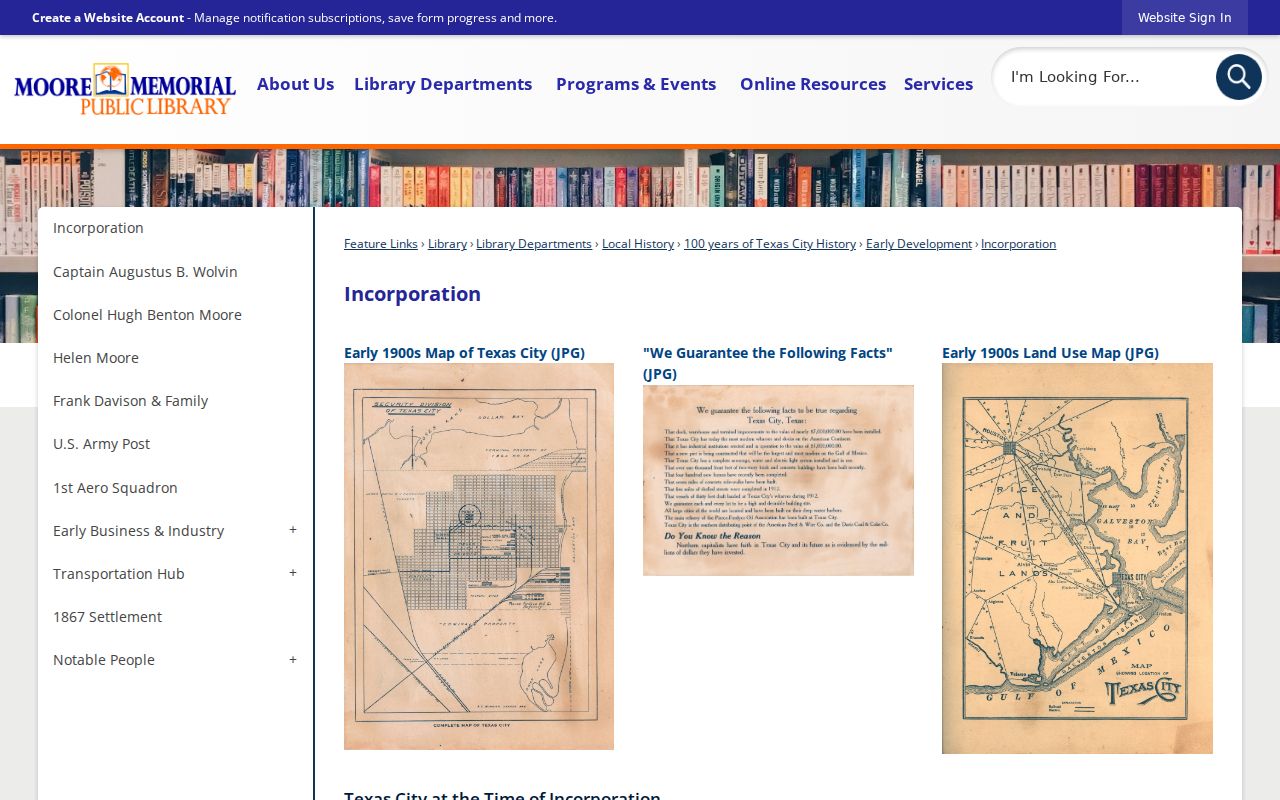
The early maps and development material can help place a street in time. They do not replace a deed or establish a person's ownership or household membership.
Texas City Permit Change Trail
Building records can explain when an address changed even though they do not replace the deed chain. Texas City moved new permit and inspection processing to MGO on June 4, 2025. For a project before the transition, contact Building Inspections for existing records or submit a written request under the Texas Public Information Act. The MGO path requires registration or login, and accessible official material does not state its historical online cutoff.
Permit applications and plans can identify the parcel or street, applicant or owner, project type, inspection dates, and completion information where releasable. Treat those items as dated construction evidence, not as a complete list of past residents.
Texas City Archives Preserve Context
Moore Memorial's Local History Archives collect directories, newspapers, maps, photographs, oral histories, yearbooks, genealogy books, and more. Original materials do not circulate. Access is by prior appointment with staff, who supervise original use; surrogate copies may be supplied, and cameras are generally allowed on request. That access model is a practical fallback for an address that cannot be solved through the online deed index.
Moore Memorial's Texas City History exhibit supplies the historical context in this image.

Preserved maps and photographs can date a street, institution, or structure. Save the collection caption and date with the finding, because an archival image alone does not prove who lived at an address.
Texas City Sun Digitization
The Texas City Sun is a long-running bridge between directory years and recorded deeds. Moore lists microfilm from 1934 through 2004, available through local history. The Texas State Library and Archives Commission's 2026 TexTreasures recipients list names Moore Memorial for a second-year project to digitize Texas City Sun microfilm from 1960-1971. That award signals planned access, not proof that every reel or name is already searchable online.
Newspapers can surface obituary notices, marriage or anniversary items, school and community references, and public notices. Pair a notice with the actual deed, probate file, or certificate before treating a relationship or address as settled.
Texas City Previous Residents Limits
Past records have blind spots. A property owner is not necessarily every person who lived at the address. A directory can reflect a telephone subscriber, and a census has its own date and geographic units. Utility customer information, motor-vehicle address data, protected voter addresses, sealed records, and other private household details are not part of an open address trail. Leave a gap visible when the record trail cannot support a conclusion.
Lawful use. Texas City house-history research supports personal, family, and property history. Do not use past-resident information to stalk, harass, intimidate, or harm anyone.